Dimensionally Stable Titanium Anode for High-Flow-Rate Sewage Electrolysis
2026-06-09 11:18:41
Industrial and municipal wastewater treatment faces increasingly stringent discharge standards, and electrochemical oxidation technology continues to gain engineering attention for its capability to address recalcitrant organic pollutants. Under demanding operating conditions—high flow rates, high conductivity, or elevated temperatures—electrode dimensional stability becomes a critical factor influencing long-term system reliability. The titanium anode for electrolytic sewage treatment, known as the Dimensionally Stable Anode (DSA), is an electrochemical core component engineered for such operating environments.
Dimensional Stability: Engineering Value Under High-Flow-Rate Conditions
In sewage electrolysis cells, minor variations in electrode spacing directly affect current distribution uniformity and cell voltage stability. Traditional graphite or lead-based anodes gradually change their geometry during operation due to material loss, leading to expanded electrode gaps, rising cell voltage, and ultimately compromised treatment consistency.
Our titanium anode for electrolytic sewage treatment employs high-purity corrosion-resistant titanium (Grade 1 or Grade 2) as the substrate. Under anodic polarization conditions, the titanium substrate spontaneously forms a dense passive oxide film, a characteristic that helps the electrode maintain geometric integrity in corrosive sewage environments. Under typical conditions, electrode thickness and surface profile remain relatively stable throughout the service cycle, and the inter-electrode gap does not undergo significant changes due to anode consumption. For high-flow-rate sewage systems, this dimensional stability helps current distribution stay within the designed range, thereby supporting batch-to-batch consistency in treatment performance. (Disclaimer: Actual stability performance depends on combined factors including sewage composition, flow rate, and operating parameters.)

Coating System: A Catalytic Interface Engineered for Long-Term Operation
On the stable titanium substrate, the noble metal oxide coating performs the electrocatalytic function. Coating formulations are typically based on RuO₂-IrO₂-TiO₂ ternary systems or Pt-containing compositions, with coating thickness generally controlled within the 5 to 15 micrometer range. This coating functions not as a simple protective overlay, but as a provider of active sites for the anodic oxidation of complex organic compounds in sewage.
At the coating design level, composition ratios and microstructural tuning serve two objectives: lowering the overpotential for the oxygen evolution reaction, so that the electrolysis unit can operate at a lower cell voltage for a given current density, helping to control long-term energy consumption; and maintaining electrochemical activity in sewage environments, enabling relatively stable current efficiency under typical conditions in actual wastewater containing suspended solids, oils, or complex ionic species. The coating consumption rate is relatively gradual, and under appropriate current density and water quality conditions, the electrode can provide multiple years of effective working life under ideal operating conditions. (Disclaimer: Actual working life and current efficiency vary depending on water quality conditions, operating temperature, and maintenance practices.)
Geometric Configurations for Engineering Adaptability
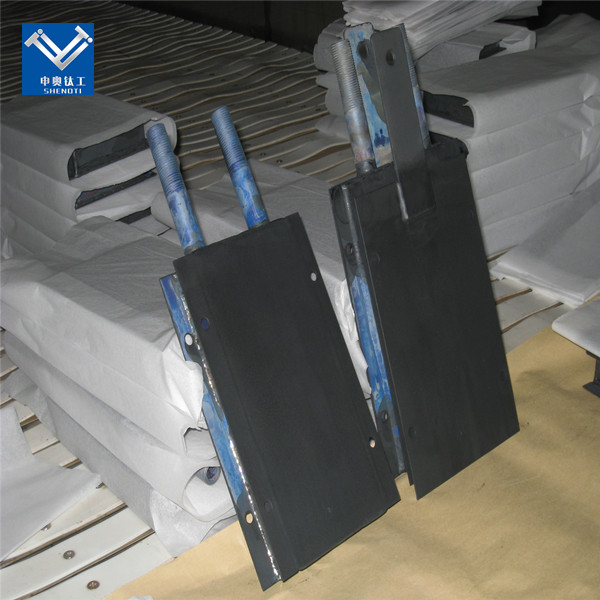
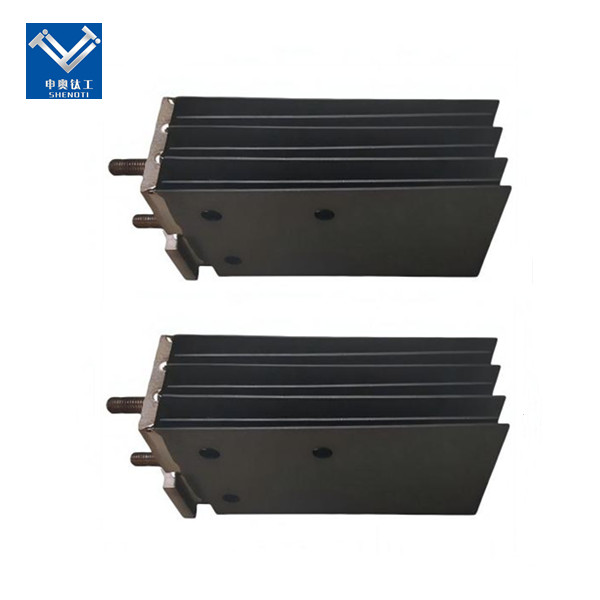
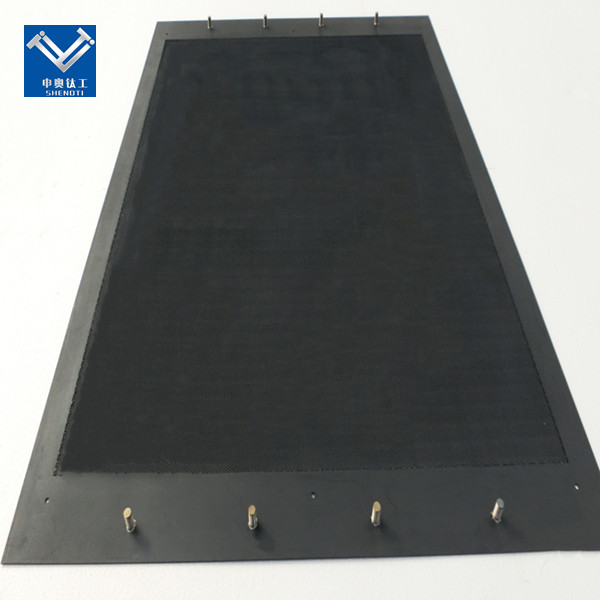
Different sewage treatment scenarios place varied demands on electrode geometry. Plate electrodes suit immersion-type reactors requiring large effective surface areas. Mesh electrodes help enhance mass transfer efficiency, making them suitable for high-flow-rate side-stream treatment units. Tubular electrodes are commonly found in tubular electrolysis reactors with specific flow channel designs.
Our titanium anode for electrolytic sewage treatment is available in plate, mesh, tubular, and customized geometric configurations to accommodate the reactor designs of different system integrators. Regardless of the geometry selected, the substrate and coating system remain consistent, ensuring predictable electrochemical performance across different configurations. The operating temperature tolerance up to 80°C also enables the electrode to adapt to temperature fluctuations that may occur in industrial wastewater and municipal sewage applications.
Operational Considerations for Total Lifecycle Cost
For wastewater treatment facility operators, electrode replacement frequency and maintenance workload directly impact total lifecycle costs. The dimensional stability and coating durability of the titanium anode jointly form the engineering foundation for extended replacement intervals.
Under appropriate operating conditions, the titanium anode for electrolytic sewage treatment can provide an extended service cycle under typical conditions. This means that within the system's design life, electrode replacements are relatively infrequent, helping to reduce downtime and labor costs associated with replacement operations. At the same time, stable electrode spacing and cell voltage also help simplify routine maintenance procedures, allowing operators to focus on electrical parameter monitoring and water quality indicator tracking rather than frequent mechanical adjustments. (Disclaimer: Actual working life depends on combined factors including sewage composition, current density, operating temperature, and maintenance practices. Performance may vary across different application scenarios.)
Engineering Reliability for Global Markets
In the global wastewater treatment market, particularly in regions with stringent industrial effluent discharge regulations, the application of electrochemical oxidation technology is expanding. Buyers selecting titanium anodes for electrolytic sewage treatment are shifting their focus from initial procurement cost alone to total cost of ownership, encompassing service life, maintenance frequency, and energy consumption levels.
Our titanium anode product is designed based on this market understanding. It is not positioned as a universal solution for all water qualities, but rather as an engineering-validated core component option for sewage treatment systems operating under demanding conditions where electrode dimensional stability is a clear requirement. We encourage environmental engineering firms and industrial users to conduct bench-scale or pilot validation based on the actual characteristics of their target wastewater and system operating parameters. By tracking indicators such as cell voltage stability, current efficiency, and pollutant removal rates, the long-term performance of the titanium anode in specific application environments can be evaluated.
Important Note: Descriptions regarding electrode working life, current efficiency, and treatment effectiveness are based on engineering experience under typical conditions or internal test data. Actual product performance depends on combined factors including sewage composition, conductivity, temperature, flow rate, system design, and maintenance practices. Performance may vary across different application scenarios. This product is designed for industrial and municipal wastewater treatment applications. Prospective buyers are encouraged to conduct sufficient compatibility validation under actual sewage quality and operating conditions before bulk procurement.
Titanium Anode Manufacturer
Email: zh@baojiti.com.cn
Products: Titanium Anodes, MMO Titanium Anodes, DSA Coated Titanium Electrodes, Electrolysis Electrodes, Hydrogen Production Electrodes, Wastewater Treatment Titanium Anodes.