Copper Clad Aluminum Material for Lightweight Load Reduction to Alleviate Structural Vibration Stress in Industrial Power Distribution
2026-07-27 10:27:48
In industrial power distribution systems, pure copper busbars and transformer windings carry substantial weight, imposing continuous mechanical loading on support insulators, cabinet frames, and installation foundations. Under vibration conditions—such as transformer magnetostrictive vibration, high-current electromagnetic forces, and equipment start-stop shocks—the heavy deadweight of conductors intensifies fatigue accumulation in support structures. Long-term operation may lead to fastener loosening and structural member cracking. Copper clad aluminum material, with an aluminum core reducing deadweight and a copper layer carrying current, aims to provide a lightweight and vibration-resistant composite conductor solution for industrial power distribution.
Lightweighting for Vibration Mitigation: Reducing Structural Fatigue Through Weight Reduction
Industrial power distribution equipment endures multiple vibration sources during operation. Transformer core magnetostriction generates 100Hz/120Hz fundamental frequency vibration, short-circuit currents passing through busbars produce electromagnetic forces that trigger transient mechanical shocks, and large switch operations are accompanied by mechanical vibration transmission. The greater the deadweight of pure copper busbars, the larger the inertial forces acting on support insulators and fasteners under vibration conditions, correspondingly shortening structural fatigue life.
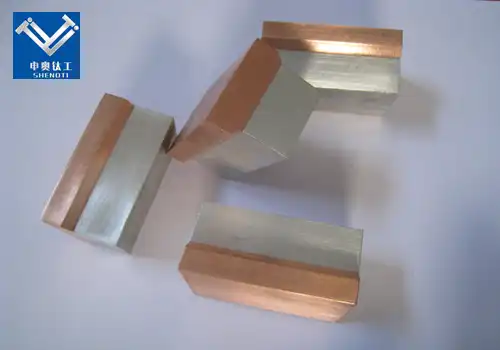
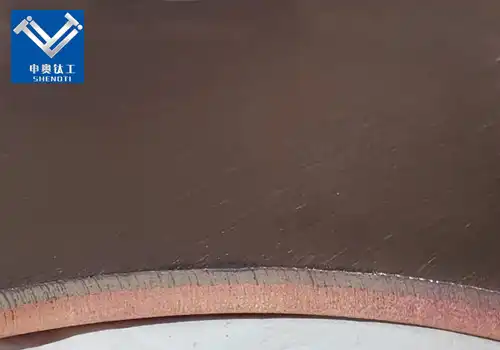
Copper clad aluminum material replaces the core copper with aluminum, which has only one-third the density of copper, substantially reducing conductor deadweight while maintaining equivalent current-carrying capacity. This weight reduction directly decreases the dynamic loads borne by support structures during vibration, helping to reduce the risk of fastener loosening and support insulator fatigue cracking. In AC distribution applications, the skin effect causes current to concentrate near the conductor surface layer. Copper clad aluminum material utilizes this characteristic for material optimization: the outer copper layer carries the primary current, while the aluminum core provides structural support. The interface between copper and aluminum is integrally connected through metallurgical bonding processes, with the bonding interface exhibiting a wavy interlocking morphology that effectively increases the bonding area and mechanical interlocking force between the two metals, supporting the composite conductor in maintaining interlayer integrity under long-term vibration environments. Actual weight reduction and vibration resistance performance vary depending on copper-to-aluminum thickness ratio, vibration spectrum, installation span, and operating current.
Performance varies based on specific operating conditions. Actual results depend on operating conditions and design parameters.

Interfacial and Electrical Reliability: Long-Term Stability Under Vibration Conditions
Vibration environments place higher demands on the long-term reliability of electrical connections. If the conductor material itself has interfacial defects, vibration stress may accelerate microcrack propagation, leading to interlayer delamination and increased contact resistance, causing localized overheating when high current passes through. The difference in thermal expansion coefficients between copper and aluminum generates thermal stress during load temperature fluctuations, which superimposes with mechanical vibration to create a composite test of interfacial bonding quality.
Copper clad aluminum material achieves integrated connection between the copper layer and aluminum core through metallurgical bonding, with relatively low interfacial electrical resistance. Under the combined effects of repeated vibration and thermal cycling, the metallurgical bonding interface can effectively transfer and disperse mechanical stress and thermal stress, helping to suppress microcrack initiation and propagation, and supporting long-term stability of electrical connections. The copper-to-aluminum thickness ratio can be custom designed according to specific current-carrying capacity, short-circuit withstand, and mechanical strength requirements to meet the application demands of different voltage levels and installation environments.
Engineering Value for the Industrial Power Distribution Market
In the global industrial power distribution market, installation convenience and long-term operational reliability are core indicators of user concern. The engineering value of copper clad aluminum material in this market lies in replacing copper with aluminum to reduce conductor deadweight, optimizing the comprehensive reliability and installation economy of power distribution systems from the perspective of reducing structural loading and alleviating vibration fatigue.
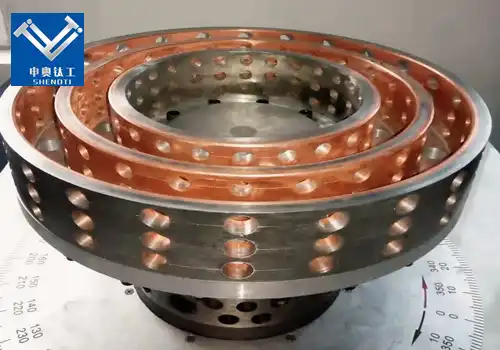
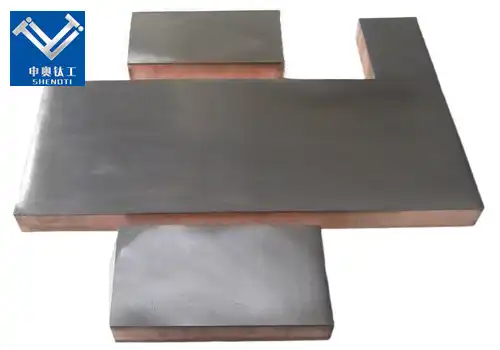
These copper clad aluminum material products are manufactured using metallurgical bonding processes, with the copper-to-aluminum thickness ratio customizable within a thickness range of 1 mm to 100 mm according to current-carrying capacity, short-circuit withstand, and mechanical strength requirements. They are suitable for industrial power distribution scenarios such as transformer windings, switchgear busbars, and high-current connection bars. It is recommended that power distribution equipment manufacturers and industrial users conduct field condition testing of copper clad aluminum materials based on their rated current, vibration conditions, and installation environment. By tracking indicators such as temperature rise, contact resistance variation trends, and long-term vibration operation performance, the technical compatibility and comprehensive economic benefits of the copper aluminum composite solution in specific industrial power distribution scenarios can be evaluated.
Important Note: The performance descriptions above are based on engineering experience under specific test conditions or internal test data. Differences may exist between laboratory results and actual operating conditions. Actual current-carrying performance, bonding strength, and working life vary depending on copper-to-aluminum thickness ratio, current frequency, vibration spectrum, temperature fluctuation range, installation environment, and system design. This product is a composite material for power distribution equipment, and its suitability for specific applications must be verified by the user according to actual operating conditions and relevant industry standards.
Titanium Anode Manufacturer
Email: zh@baojiti.com.cn
Products: Titanium Anodes, MMO Titanium Anodes, DSA Coated Titanium Electrodes, Electrolysis Electrodes, Hydrogen Production Electrodes, Wastewater Treatment Titanium Anodes.