
Platinized Titanized Anode: The Ultimate Solution for High-Efficiency Industrial Electrochemistry
2026-04-15 15:02:15
Platinized Titanized Anode: The Ultimate Solution for High-Efficiency Industrial Electrochemistry
In today's rapidly evolving industrial landscape, the demand for reliable, energy-efficient, and long-lasting electrochemical components has never been higher. At the heart of countless critical processes lies the platinized titanized anode—a revolutionary electrode material that combines the exceptional corrosion resistance of titanium with the unparalleled catalytic activity and conductivity of platinum. Also known as platinum coated titanium anode or platinum plated titanium anode, this advanced material has transformed industries ranging from electroplating to water treatment, chlor-alkali production to new energy development.
Unlike traditional lead or graphite anodes that suffer from rapid degradation, high energy consumption, and environmental concerns, the platinized titanized anode offers a sustainable, cost-effective alternative that delivers consistent performance over extended periods. With a service life 2-10 times longer than conventional electrodes and energy savings of up to 40%, it has become the preferred choice for forward-thinking manufacturers worldwide. In this comprehensive guide, we will explore everything you need to know about platinized titanized anodes, from their intricate manufacturing process to their diverse industrial applications and technical specifications.
What is a Platinized Titanized Anode?
A platinized titanized anode is a dimensionally stable anode (DSA) consisting of a high-purity titanium substrate coated with a thin, uniform layer of metallic platinum. This innovative composite material leverages the best properties of both metals: titanium provides exceptional mechanical strength and resistance to corrosion in aggressive electrolytes, while platinum serves as the active electrochemical surface with outstanding conductivity and catalytic performance.
Core Structure and Composition
The platinized titanized anode features a two-layer structure that is engineered for maximum durability and efficiency:
Titanium Substrate: Made from Grade 1 or Grade 2 industrial pure titanium (≥99.5% purity) according to ASTM B265 standards. This base material offers excellent corrosion resistance in pH ranges from 1 to 14 and can withstand operating temperatures up to 85°C.
Platinum Coating: A thin layer of 99.95% pure platinum applied through advanced electroplating or thermal decomposition techniques. Coating thickness typically ranges from 0.1 to 20 micrometers, customized based on specific application requirements and expected service life.
Common Types and Shapes
To accommodate diverse industrial needs, platinized titanized anodes are available in a wide range of configurations:
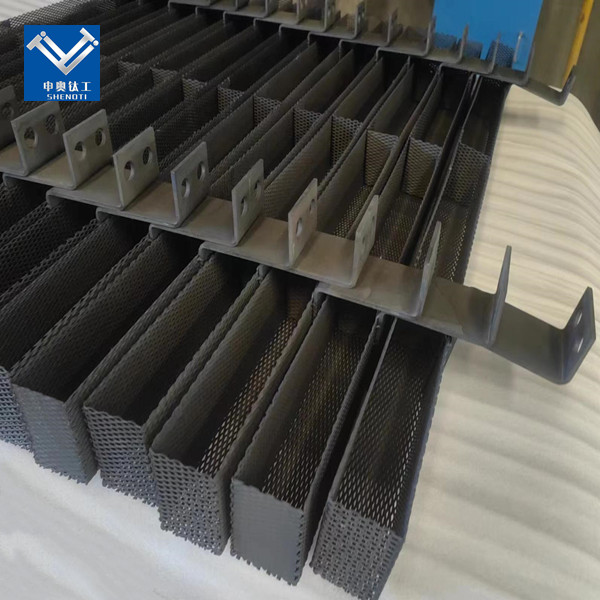
Mesh Anodes: Expanded or perforated titanium mesh substrates that facilitate rapid gas release, reducing bubble coverage by approximately 30% and significantly enhancing electrolysis efficiency. Ideal for general electroplating and water treatment applications.
Plate Anodes: Solid titanium plates with uniform platinum coating, providing excellent current distribution and dimensional stability. Perfect for flat-surface electroplating and large-scale electrolysis cells.
Rod Anodes: Solid titanium rods coated entirely or partially with platinum, designed for deep holes, cylindrical equipment, or confined spaces. Available in diameters from 3mm to 50mm and various lengths.
Tubular Anodes: Hollow titanium tubes that can accommodate internal cooling systems or direct fluid flow. Suitable for high-temperature, high-flow rate reaction environments with outer diameters ranging from 10mm to 200mm.
Wire Anodes: Thin titanium wires with platinum coating, ideal for detailed and complex connectivity requirements in microelectronics and precision manufacturing.
Advanced Manufacturing Process of Platinized Titanized Anodes
The performance and longevity of a platinized titanized anode depend entirely on the precision of its manufacturing process. Our state-of-the-art production facility employs a rigorous 8-step process that ensures every anode meets the highest quality standards:
1. Titanium Substrate Selection and Processing
We begin by selecting only the highest quality Grade 1 or Grade 2 titanium materials, verified through rigorous chemical and mechanical testing. The titanium is then precisely cut, bent, and welded into the desired shape (mesh, plate, rod, tube, or custom configuration) according to customer specifications.
2. Surface Preparation: Sandblasting
The titanium substrate undergoes high-pressure abrasive blasting to create a controlled micro-rough surface. This process increases the specific surface area by up to 40% and provides excellent mechanical adhesion for the subsequent platinum coating.
3. Acid Pickling and Activation
Following sandblasting, the substrate is immersed in a heated oxalic acid solution (10% concentration, slight boiling state) for 2 hours. This critical step removes all surface oxides, contaminants, and residual blasting media, converting the titanium surface to titanium hydride and activating its chemical reactivity.
4. Ultrasonic Cleaning
The activated titanium substrate is then thoroughly cleaned in an ultrasonic bath with deionized water and alcohol to remove any remaining acid residues and particles. This ensures a pristine surface for optimal platinum adhesion.
5. Precision Platinum Coating
We employ advanced electroplating technology to deposit a uniform layer of 99.95% pure platinum onto the prepared titanium surface. Our proprietary plating process allows for precise control of coating thickness (±0.1μm tolerance) and ensures complete coverage even on complex geometries.
6. High-Temperature Sintering Reinforcement
After plating, the platinized titanized anode is processed in a vacuum sintering furnace at temperatures exceeding 1200°C. This step induces a chemical reaction between the platinum atoms and titanium surface, forming a dense intermetallic bond layer that prevents coating detachment and extends service life.
7. Quality Inspection and Testing
Every platinized titanized anode undergoes comprehensive quality testing, including:
Coating thickness measurement using X-ray fluorescence (XRF)
Adhesion testing to ensure no peeling or cracking
Electrical conductivity verification
Dimensional accuracy inspection
Corrosion resistance testing in simulated operating environments
8. Custom Finishing and Packaging
Finally, the anodes are finished with integrated titanium plates or threaded terminals for easy installation and stable electrical contact. They are then carefully packaged in export fumigated wooden boxes to ensure safe delivery worldwide.


YOU MAY LIKE
_1735019249058.webp "Zirconium alloy steel clad plate")
(1)_1734580705587.webp "Titanium Prints")