
MMO Titanium Electrodes vs. Graphite Electrodes: Which is More Corrosion Resistant
2026-04-21 11:47:25
In electrochemical processes—whether wastewater treatment, electroplating, or chemical processing—electrodes are more than just "parts"; they are the core of the system. Choosing the wrong electrode can lead to rapid corrosion, unstable performance, and high replacement costs.
The real question is: MMO titanium electrodes and graphite electrodes—which is more corrosion resistant? Let us explain in detail, combining real-world application scenarios and results, to help you make the right choice.
What are MMO Titanium Electrodes and Graphite Electrodes?
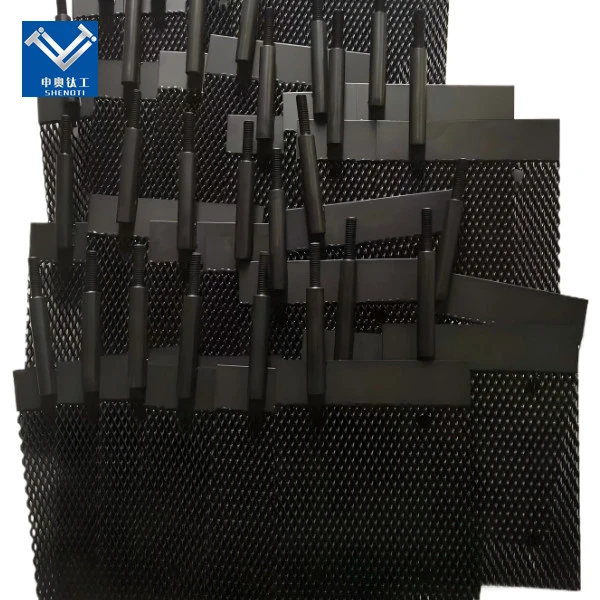
MMO Titanium Electrodes (Mixed Metal Oxide Coating)
MMO titanium electrodes consist of a titanium substrate coated with a mixed metal oxide (e.g., RuO₂, IrO₂, etc.).
Simple Concepts:
Titanium = Robust and Corrosion-Resistant Framework
MMO Coating = Active Layer, Responsible for Electrochemical Reactions
Long service life, maintaining stable performance even in harsh environments.
Graphite Electrodes
Graphite electrodes are made of carbon materials. They are inexpensive and have good conductivity, making them widely used.
Simple Concepts: Low initial cost
Easy to manufacture
Good performance under mild conditions
Graphite is a consumable—it slowly decomposes during use.
Corrosion Resistance: The Real Difference
MMO Titanium Electrodes: Designed for Corrosion Resistance
MMO titanium electrodes are designed for harsh environments:
Extremely resistant to acidic and alkaline solutions
Stability at high current densities
A natural protective oxide layer forms on the titanium substrate
Coating prevents rapid degradation
Practical Effects: Less material loss
Long-lasting and stable performance
Extremely low maintenance
Graphite Electrodes: Consumable
Graphite electrodes are not "corrosion-resistant," but rather degrade:
Oxidation leads to carbon loss
Gradual surface erosion
Sludge and contaminants form
Performance declines over time
Practical Impacts: Frequent replacements
Instable processes
Higher long-term costs
Application Areas Applications of Various Electrodes
Wastewater Treatment
1: Application of MMO Titanium Electrodes in Wastewater Treatment
Applications:
Industrial wastewater (chemical plants, textile printing and dyeing, etc.), pharmaceuticals)
Electro-oxidation systems
Disinfection processes
Advantages of MMO:
Can handle high-chloride environments
Generates strong oxidants (such as chlorine and hydroxyl radicals)
Long service life (typically 2-5 years or more)
Case Study: A chemical plant replaced graphite electrodes with MMO titanium electrodes in its electrochemical oxidation system:
Electrode life increased from 3 months to over 2 years
Maintenance downtime reduced by 70%
COD removal rate increased by 25%
Stability + Durability = Lower operating costs.
2: Application of Graphite Electrodes in Wastewater Treatment
Applications:
Small or low-cost systems
Temporary installations
Limitations:
Rapid wear in high-salinity wastewater
Carbon particles can contaminate treated water
Results: Suitable for short-term use – not suitable for continuous industrial operation.
3: Electroplating Industry
1: MMO Titanium Electrode
Application Areas:
Chromium Plating
Copper Foil Production
PCB Manufacturing
Advantages:
Acid-resistant plating solution
Stable current distribution
No plating solution contamination
Case Study: A PCB manufacturer replaced graphite anodes with MMO titanium electrodes:
Impurities and defects reduced by 30%
Plating uniformity improved
Electrode replacement cycle extended from once a month to once a year
Product quality + process consistency
2. Graphite Electrode
Applications: Low-end electroplating processes
Problems: Particle shedding → surface defects
Poor dimensional stability
Results: High scrap rate, unstable product quality.
4. Chlor-alkali and Electrochemical Production
Applications: Chlorine production
Sodium hypochlorite production
Seawater electrolysis
Advantages: Chlorine corrosion resistance
High catalytic efficiency
Energy saving performance
Case Study: A seawater electrolysis plant: Switching to MMO electrodes → Energy consumption reduced by 15%
Electrode lifespan exceeded 5 years
Energy saving and high efficiency + long-term reliability.
2. Graphite Electrode
Limitations: Rapid degradation in chlorine-rich environments
Structural damage under high current
Results: Not suitable for modern industrial electrolysis systems.
5. Cathodic Protection Systems
1. MMO Titanium Electrode
Applications: Pipeline protection, Marine structures, Underground tanks
Advantages: Extremely low consumption rate, Decades of stable output
Case Study: Offshore platform protection system: MMO electrode lifespan exceeds 15 years, Extremely low maintenance requirements, Long-term asset protection
2. Graphite Electrode
Problems: High brittleness, prone to cracking, Consumable over time
Results: Frequent replacement required in harsh environments
Technology Comparison: MMO vs. Graphite
|
Feature |
MMO Titanium Electrodes |
Graphite Electrodes |
|
Corrosion Resistance |
Excellent |
Poor to moderate |
|
Lifespan |
2–10+ years |
Weeks to months |
|
Stability |
Very high |
Decreases over time |
|
Maintenance |
Low |
High |
|
Contamination |
None |
Carbon shedding |
|
Cost (Initial) |
Higher |
Lower |
|
Cost (Long-term) |
Lower |
Higher |
Why are MMO titanium electrodes superior in corrosion resistance?
Simply put:
Graphite degrades slowly.
MMO titanium electrodes remain stable and continue to function.
Main reasons:
The titanium substrate is not easily corroded.
The MMO coating is chemically stable.
The electrochemical reaction occurs on the coating, not the base metal.
MMO electrodes do not lose material; they maintain their structure and performance.
When should graphite still be used?
Graphite electrodes are still suitable in the following situations:
Extremely limited budget
The system is temporary
The environment is mild (low risk of corrosion).
However, for harsh industrial applications, graphite is usually only a short-term solution.
Choosing the right electrode: Practical advice
If you need:
Long-term operation
High corrosion resistance
Stable performance
Low maintenance costs
Superior product quality
If you only need a short-term solution
Cost is the only consideration
Which electrode has better corrosion resistance?
Short answer:
MMO titanium electrodes have far superior corrosion resistance compared to graphite electrodes.
Detailed answer:
Even with a higher initial cost, MMO titanium electrodes offer longer service life, better performance, and less downtime, resulting in greater long-term cost savings. Ready to upgrade your electrochemical system?
If your existing system suffers from the following issues: frequent electrode replacements, unstable performance, or high maintenance costs, it's time to switch to MMO titanium electrodes.
Contact us today for: custom electrode design, application-specific coating solutions, and industry technical support. We help you build systems with longer lifespans, cleaner operation, and lower long-term costs.


YOU MAY LIKE
_1777257561181.jpg "Titanium anode for copper recovery from etching solution")