10mm Copper Aluminum Transition Plate for Galvanic Corrosion Resistance and Reliable Outdoor Substation Connections
2026-07-10 09:01:59
In substations and outdoor circuit breakers, the dissimilar metal connection points between copper busbars and aluminum conductors are subjected to the combined stresses of moisture, salt spray, and thermal cycling over extended periods. Direct copper-aluminum contact forms a galvanic couple in electrolyte environments, with the aluminum side undergoing accelerated corrosion due to its lower electrochemical potential. Contact resistance rises accordingly, potentially leading to localized overheating or even connection failure under heavy load conditions. The 10mm copper aluminum transition plate, which replaces mechanical clamping with metallurgical bonding, aims to provide a composite conductive solution resistant to galvanic corrosion and adaptable to thermal cycling for outdoor substation connections.
Galvanic Corrosion Suppression: Metallurgical Bonding Eliminating Interfacial Penetration Pathways
Traditional copper-aluminum connections predominantly employ bolted clamping or brazing. Under long-term thermal cycling and outdoor corrosive environments, bolted connections experience progressive thickening of contact surface oxide films, with fastener stress relaxation leading to continuously rising contact resistance. Brazing, while achieving localized connection, presents risks of softening or creep in the low-melting-point solder layer under high-temperature and high-current conditions, with flux residues potentially accelerating interfacial corrosion. Neither of these mechanical or semi-metallurgical connection approaches can fundamentally eliminate microscopic gaps at the copper-aluminum interface, through which corrosive media can still penetrate and sustain ongoing galvanic corrosion.
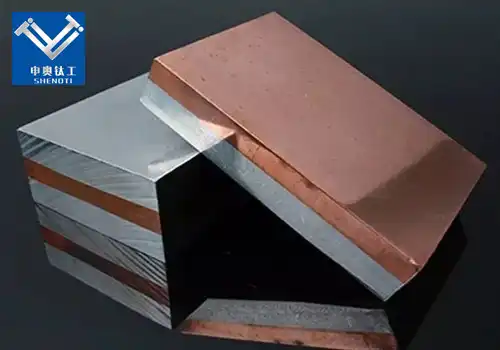
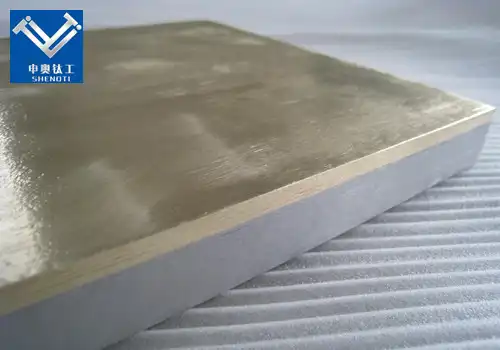
The 10mm copper aluminum transition plate achieves full metallurgical bonding between the copper and aluminum layers through the explosive welding process. Explosive welding utilizes high-velocity impact energy to drive the copper and aluminum plates into oblique collision, with the instantaneous high pressure at the collision point causing plastic deformation and jetting of the interfacial metals, forming atomic-scale bonding. The interface exhibits a wavy interlocking morphology with increased bonding area, without the introduction of solder or intermediate layers. The dense metallurgical bonding surface can effectively block the penetration pathways of corrosive media, helping to reduce the tendency for galvanic corrosion at the design level. The 10mm thickness design of both the copper and aluminum layers balances current-carrying cross-section requirements with mechanical strength needs. Actual corrosion resistance performance varies depending on ambient humidity, salt spray concentration, temperature fluctuations, and current loading in the operating environment.
Performance varies based on specific operating conditions. Actual results depend on the operating environment and working parameters.

Thermal Cycling Stability: Meeting the Long-Term Challenge of Outdoor Day-Night Temperature Variations
Outdoor substation equipment experiences substantial temperature fluctuations through day-night and seasonal cycles, with current load variations further intensifying the thermal alternation at connection points. The thermal expansion coefficients of copper and aluminum are approximately 17×10⁻⁶/K and 23×10⁻⁶/K respectively, with each temperature change generating thermal stress at the bonding interface. If bonding quality is insufficient, long-term cycling will lead to microcrack accumulation and interlayer delamination.
The metallurgical bonding interface of the 10mm copper aluminum transition plate can disperse and transfer the stress generated by thermal expansion differences across the larger area of the wavy interface during repeated thermal cycling, helping to suppress microcrack initiation and propagation. The copper side connects to copper busbars, and the aluminum side connects to aluminum conductors, with each side interfacing with the same metal, eliminating the galvanic corrosion problem caused by dissimilar metal contact at its source. The 10mm thickness provides sufficient mechanical support area for fastened connections, supporting the stable retention of bolt tightening torque. Actual interfacial stability and service life vary depending on temperature fluctuation range, cycling frequency, current loading, and installation environment.
Engineering Value for the Substation Connection Market
In the global power transmission and distribution market, the reliability of outdoor substation connections is directly linked to grid operational safety and maintenance costs. The engineering value of the 10mm copper aluminum transition plate in this market lies in replacing mechanical connections with metallurgical bonding, helping to reduce the risks of galvanic corrosion and thermal fatigue failure, and supporting substation equipment in achieving long-cycle stable operation under harsh outdoor climatic conditions.
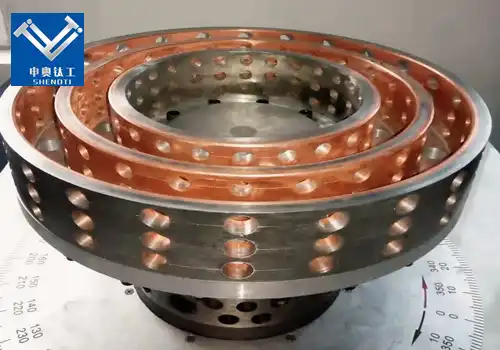
These copper aluminum transition plate products are manufactured using the explosive welding process, with both copper and aluminum layer thicknesses at 10mm, and can be custom fabricated according to current-carrying capacity and installation dimension requirements. They are suitable for outdoor electrical connection scenarios such as substation copper-aluminum transition bars, circuit breaker terminal pads, and disconnect switch connection bars. It is recommended that substation equipment manufacturers and power engineering firms conduct field condition testing of 10mm copper aluminum transition plates based on their equipment's current loading, installation environment, and climatic conditions. By tracking indicators such as contact resistance variation trends, interfacial bonding integrity, and long-term operating performance, the technical compatibility and operational reliability of the copper-aluminum transition solution in specific substation connection scenarios can be evaluated.
Important Note: The performance descriptions above are based on engineering experience under specific test conditions or internal test data. Differences may exist between laboratory results and actual operating conditions. Actual corrosion resistance performance, bonding strength, and working life vary depending on ambient humidity, salt spray concentration, temperature fluctuation range, current loading, mechanical stress, and installation methods in the operating environment. This product is a composite material for power transmission and distribution equipment, and its suitability for specific applications must be verified by the user according to actual operating conditions and relevant industry standards.
Titanium Anode Manufacturer
Email: zh@baojiti.com.cn
Products: Titanium Anodes, MMO Titanium Anodes, DSA Coated Titanium Electrodes, Electrolysis Electrodes, Hydrogen Production Electrodes, Wastewater Treatment Titanium Anodes.